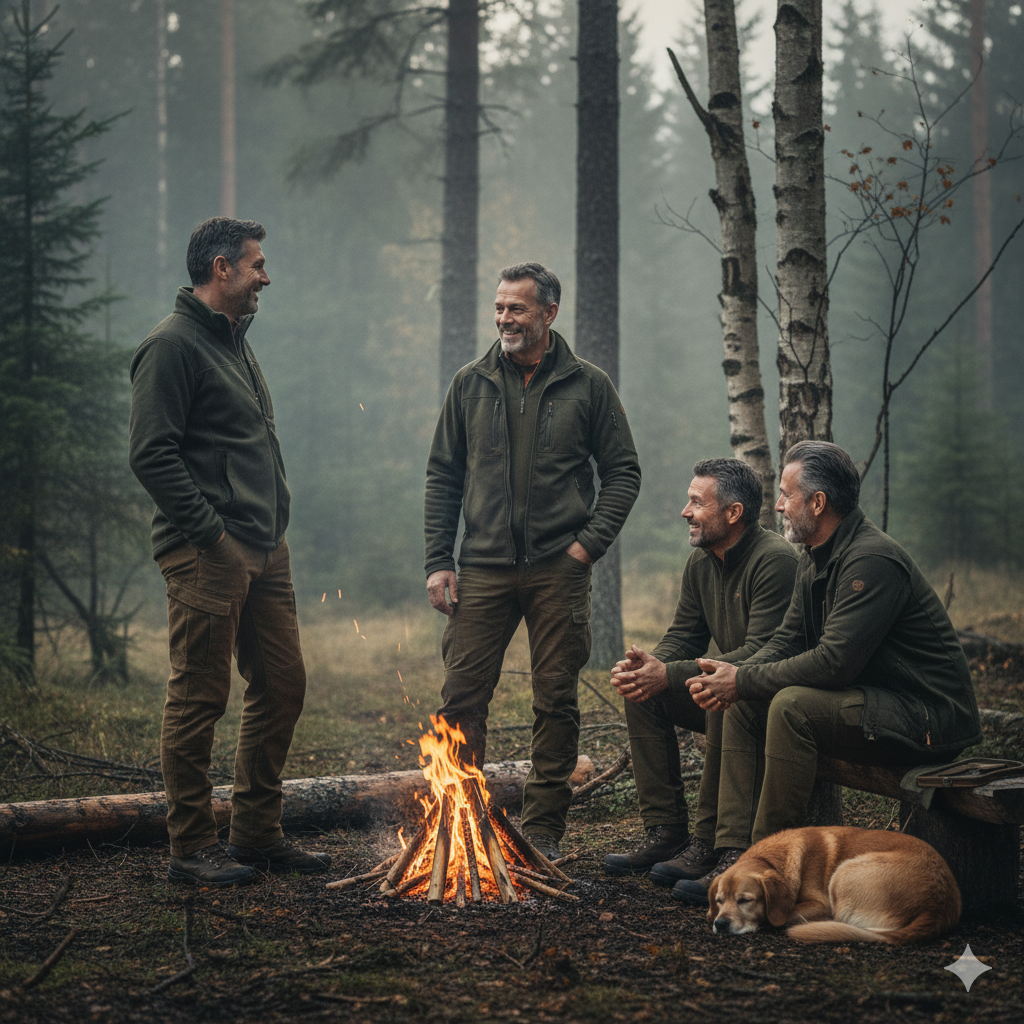
The old hunting saying goes: "There is no bad weather, only bad equipment."
However, every hunter who has spent hours on a stand shivering from the cold while their fingers go numb on the rifle, or who has been "cooking" in an overly heavy jacket while pushing through thickets during a driven hunt, knows how much the wrong choice of clothing can ruin a hunting day. A hunting jacket is not just a piece of fabric – it is your first shield against the elements and a tool that allows you to remain focused on the most important thing: the game.
Today, the market offers hundreds of models, materials, and membranes. How do you know what you really need? Is Gore-Tex necessary for you? How quiet must a jacket be?
In this guide, we will clear up all doubts and help you invest in equipment that will serve you for years. Before you explore our complete range of hunting jackets, let's define exactly what suits your hunting style best.
The first and most important criterion: How and where do you hunt?
The biggest mistake beginners make is looking for a "one-jacket-fits-all." To be honest – a jacket you won't sweat in while walking 10 kilometres on a driven hunt is unlikely to keep you warm while you sit motionless on a stand for three hours at -5°C.
Therefore, before looking at brands, define your primary purpose:
1. For Driven Hunts (Active Hunting)
In driven hunting (for wild boars or predators), your body generates heat through movement. Here, you don't need thick lining, but breathability (vapour permeability).
- What to look for: Lightweight materials, ventilation openings under the armpits, and a cut that does not restrict movement during quick shooting.
- Key detail: Safety. Choose jackets with orange details or high-visibility (Hi-Viz) camouflage. In thickets, the most important thing is that your colleagues see you in time.

2. For Stand Hunting (Passive Hunting)
Here, the number one enemy is the cold that comes from immobility. When the body is at rest, circulation slows down and the cold quickly creeps into the bones.
- What to look for: Thick thermal insulation and "heavier" materials.
- Key detail: Jacket length. A stand hunting jacket should be longer (often mid-thigh length) to cover the kidneys and lower back even when you are sitting.

3. For Stalking
Stalking (e.g., for roe deer) requires a specific balance. You move slowly, stop, observe.
- What to look for: Absolute silence.
- Key detail: Avoid rustling nylon materials. Look for jackets made of "silent" fabrics such as fleece, wool (choya/čoja), or special microfibers that don't make a sound when a branch scrapes against the sleeve. If the game hears you before you see it, even the best optics won't help you.

Materials: What's Behind the Labels?
When reading jacket specifications, it's easy to get lost in technical terms. Here's what you actually need to look at so you don't waste money on features you don't need, or miss the crucial ones.
-
Membrane (Waterproofness and Breathability)
If you hunt in rain, snow, or wet terrain, a membrane is mandatory. But, they are not all the same.
- Water column: This tells you how heavy a rain the jacket can withstand. For light drizzle, 3,000mm is enough, but for a serious downpour, look for models with 5,000mm or 10,000mm.
- Breathability: This is even more important. If the jacket doesn't breathe, you'll feel like you're in a plastic bag as soon as you warm up a little. Sweat will stay inside, and you'll become wet and cold. A quality membrane pushes moisture out but doesn't let rain in.
2. Softshell (Comfort and Movement )
Softshell has become a hit among hunters for a reason. It is the "golden mean."
- These jackets are soft, stretchy, and very comfortable to wear.
- They protect against wind and light drizzle, but they are not raincoats for a cloudburst.
- The biggest advantage: Silence and freedom of movement. They are ideal for dry weather and active hunting.
3. Silent Materials
For stalking, the material is more important than waterproofing.
- Look for jackets that have a final layer of microfibre, fleece, or modern "čoja" (wool/felt).
- The test is simple: Rub the sleeve against the sleeve. If you hear a "rustling" sound (like a bag), that jacket is not suitable for stalking a roe deer.
Functionality: Details That Make a Difference
Once you have chosen the purpose and material, it's time to look "under the hood." A hunting jacket is your tool, and a good tool must be practical. Here are three details you must pay attention to before buying:
1. Smart Pockets
A hunter always carries a lot of equipment. Where will you put it?
- Ammunition pockets: Quality hunting jackets have integrated cartridge holders (loops) inside the front pockets. This prevents ammunition rattling and allows for quick reloading.
- Radio pocket: Usually located high on the chest. It allows the antenna to stand upright (for better range) and keeps communication close to your ear, without the need to hold the device in your hand.
- "Trunk" (Back pocket): A large pocket on the lower back, lined with waterproof material. It is used for carrying small game (pheasant, hare) or for storing a cap, gloves, and a dog leash.
2. Reinforcements in Key Areas
Hunting is not a walk in the park. You push through thorns, carry a heavy backpack, and lean your weapon.
- Shoulders: Look for jackets with reinforcements on the shoulders. They prevent the rifle sling or backpack strap from quickly wearing out the material, and often have an anti-slip surface so the rifle doesn't slide off.
- Elbows: Elbow reinforcements are essential if you frequently shoot from a prone position or crawl low.
3. Hood: Nuisance or Salvation?
A hood is great when it's raining, but it can be dangerous in hunting because it narrows the field of vision and muffles sounds (you don't hear the game).
The best solution: A jacket with a detachable hood or a hood that can be packed into the collar. That way, you have it when you need it, and you put it away when it bothers you.
Size and the "Layering Principle"
One of the most common mistakes when buying online is choosing a size that is "just right." Remember: a hunting jacket is not a blazer. It should not follow the line of the body like a fashion accessory, but rather allow you freedom of movement.
To stay warm and dry, you must apply the "onion principle" (layering). Your jacket is only the outer shell, and the heat comes from within.
Here is how it looks in practice:
-
First Layer (Next to the body): Base layer (active underwear) that wicks sweat away from the skin. (A cotton t-shirt is a mistake here – it absorbs sweat and chills you).
- Middle Layer (Warmth): Hunting sweatshirt, fleece, or vest that retains body heat.
- Third Layer (Protection): Your hunting jacket that protects against wind, rain, and thorns.
Shopping tip: When choosing the jacket size, always factor in that you must have room underneath for at least one thick sweatshirt or fleece. If you are debating between two sizes (e.g., L and XL), for hunting it is almost always better to take the larger size.
A tight jacket compresses the air pockets between the layers of clothing (which are actually the insulator) and as soon as you raise your rifle to your shoulder, it will pull tight on your back and restrict movement.
Conclusion: An Investment That Pays Off in the Field
At the end of the day, the best hunting jacket is not necessarily the most expensive one, nor the one your colleague wears. The best jacket is the one that is tailored to your hunting style and the terrain you move on.
A quality jacket is a long-term investment. It is the difference between shivering that spoils a steady hand when shooting and the comfort that allows you to remain focused for hours. Don't let rain, wind, or cold drive you home before the opportunity for the right shot presents itself.
Whether you are looking for a silent model for stalking roe deer, high-visibility protection for dynamic driven hunting, or a "fortress" that will keep you warm on a frozen stand – now you know what to look for.
Ready for the season?
Click the button below and explore our carefully selected range from leading global brands. Find a jacket that will serve you for years.